


Last updated October 2026
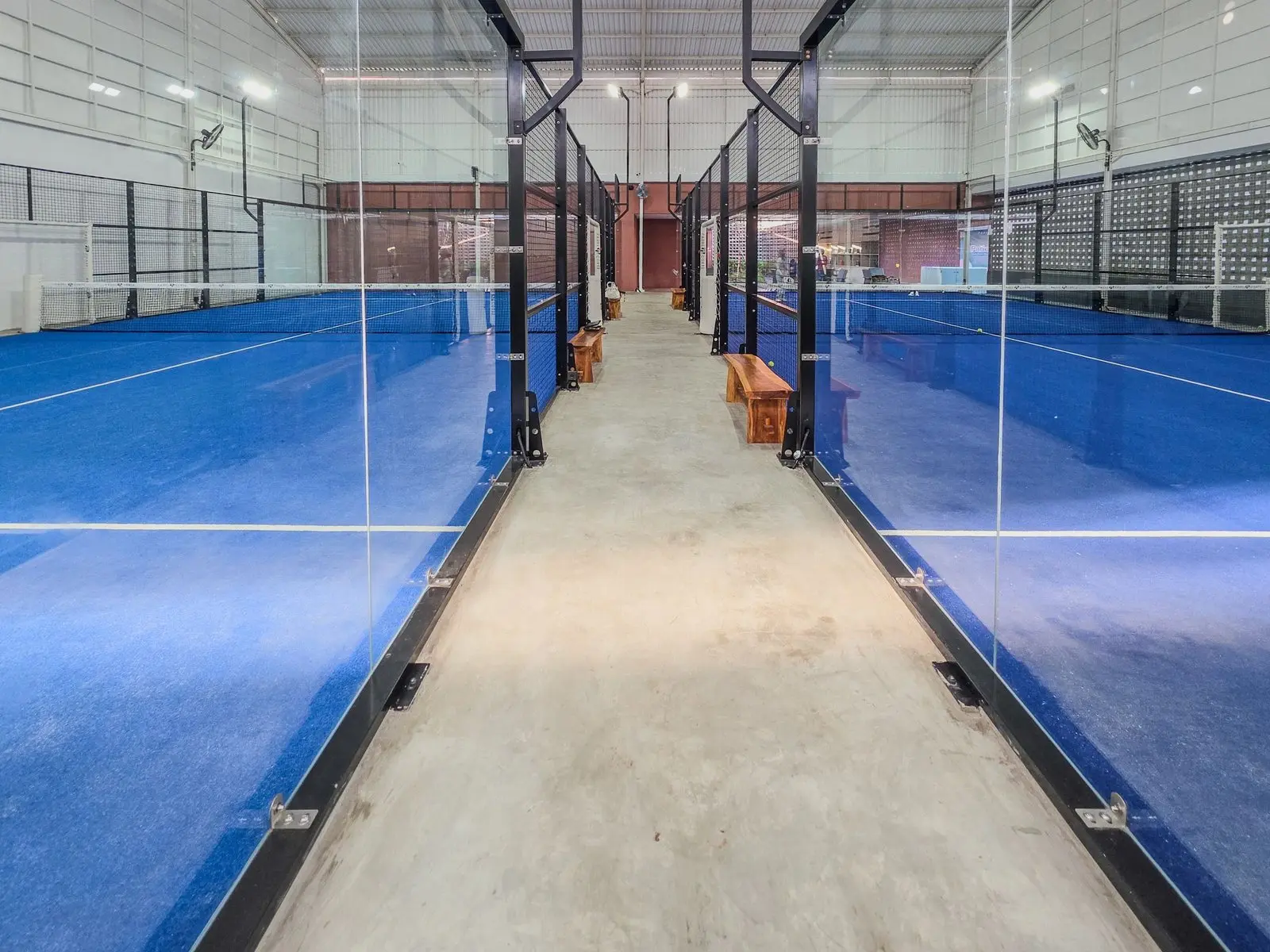
An indoor padel court typically costs £40,000 to £70,000 before the building, and indoor projects run 50 to 100% above outdoor ones because of the envelope, according to the UK Padel Guide (October 2026). Four courts need a clear floor of about 20.80m by 45.3m and at least 6m of clear height, with 8m recommended (LTA). We take operators, developers and landlords through change of use and building control, then build the courts.
Published prices for an indoor court agree on one thing: the building is extra.
| Source | Indoor court cost | What it covers |
|---|---|---|
| UK Padel Guide, 13 Oct 2026 | £40,000 to £70,000 | Court only, excluding the building |
| MyBuilder, 21 Aug 2026 | £60,000 to £80,000 | Indoor court |
| Padel Market, 14 Jul 2026 | £60,000 to £80,000 | Court, before the structure |
| UK Padel Guide | 50 to 100% above outdoor | Whole indoor project, because of the building envelope |
These are typical published figures; the sources do not all say whether VAT is included. The building is the biggest variable. We confirm the price for your building after a survey.
How much does an indoor padel centre cost?
Budget £40,000 to £70,000 per court for the courts themselves, then add the building work, which is what moves the total most. The UK Padel Guide puts indoor projects at 50 to 100% more than outdoor, and the LTA puts four outdoor floodlit courts with their base at about £268,000, so an indoor four-court centre sits well above that.
Scale examples from planning records:
- £4 million for the 11-court “Swing” centre at Riverside Business Park, Nottingham, with 8 indoor and 3 outdoor courts plus a show court (ref 26/00130/PFUL3; officers recommended approval, outcome not confirmed)
- 8 indoor courts in a 29,000 sq ft warehouse at Flaxley Parkway, Stetchford, approved by Birmingham City Council in January 2026
Inside an existing building, we survey the clear height and the floor before pricing.
What building do I need?
A clear rectangle big enough for the courts and at least 6 metres of clear height, with 8 metres recommended for new build under the LTA data sheet. The court enclosures need these footprints, before any run-off, reception or changing space:
| Courts | Enclosure footprint | Floor area |
|---|---|---|
| 1 | 20.80m x 10.80m | about 225 m2 |
| 2 | 20.80m x 22.3m | about 464 m2 |
| 3 | 20.80m x 33.8m | about 703 m2 |
| 4 | 20.80m x 45.3m | about 942 m2 |
| 5 | 20.80m x 56.8m | about 1,181 m2 |
| 6 | 20.80m x 68.3m | about 1,421 m2 |
The LTA footprints assume a 400mm ring beam and 1.5 metres between courts. Warehouses, former retail stores and indoor tennis halls have all been converted or proposed for padel; clear span and height decide whether yours can work.
How it works
- 01Tell us where you are up toSite, drawings and any council letters.
- 02Planning routePre-app, the reports and the application.
- 03BuildBase, courts and lights to the approved layout.
Do I need planning permission for a warehouse conversion?
Usually, yes. Turning an industrial or warehouse unit into a padel centre is likely to be a material change of use, says Nexa Law, and indoor padel sits in Use Class E(d) (Freeths). The question councils ask most is whether the building should stay in employment use.
Two 2026 decisions show both sides:
- Refused: Manchester City Council turned down 8 indoor courts in a Strangeways warehouse for loss of employment land (reported July 2026).
- Approved: Birmingham City Council approved 8 indoor courts in a Stetchford warehouse (January 2026), and Belfast City Council approved an indoor centre in a former warehouse on Redcar Street unanimously, with hours of 07:00 to 23:00 (March 2026).
Our planning team builds the employment land case into your padel court planning permission application from the start, with evidence about the unit and its past use.
Will I need a sequential test?
Possibly. Freeths notes that indoor padel courts may need a town centre sequential test, which asks whether a suitable site exists in or nearer a town centre before an out-of-centre one is used. Outdoor courts generally do not. If your building is out of centre, we prepare the sequential test with the application.
Can I use an empty unit on a temporary permission?
Yes, councils are granting padel on fixed-term permissions where a site has longer-term plans. Sheffield City Council approved 14 indoor courts at Parkway Close as a five-year temporary scheme, with 96 parking spaces required first. Croydon Council approved 9 enclosed courts in six temporary structures on a vacant town centre plot for up to 10 years.
A temporary permission can make a short lease workable. Our temporary padel courts page covers how these permissions are won.
What about farm buildings and Class R?
There may be a permitted development route, but check before relying on it. Muckle LLP reports that Class R of the 2015 General Permitted Development Order can allow certain agricultural buildings to change to a flexible commercial use that includes indoor sport, subject to the building being in agricultural use on 3 July 2012 (or for 10 years if later) and a 1,000 square metre cap. That cap is close to the 942 m2 enclosure for four courts. We check the order and your building’s history before you commit.
Do indoor padel courts need building regulations approval?
For a new padel hall, yes: the LTA says building control applies to fully enclosed structures. For a conversion, we confirm with building control what the works need, and run that application alongside the planning one.
Which glass and lights do indoor courts need?
Indoor courts use 10mm toughened glass, against 12mm outdoors, individually kitemarked with countersunk fixings (LTA). Lighting follows the same LTA levels as outdoor courts: 300 lux for club and recreational play and 500 lux for national competition, with fittings at least 6 metres above the court.
Is an indoor centre worth it over outdoor courts?
That depends on your market and your building costs. The UK Padel Guide’s own model, which is an estimate, shows a busy four-court venue paying back in under two years and one in a crowded market taking four to five. Those are someone else’s figures, not a promise from us; your returns depend on your site. The LTA Facility Loan Scheme prioritises covered courts for eligible not-for-profit clubs, which can help the numbers for a members’ club.
What’s included
- Building survey: clear height, span, floor and access
- Court layout to the LTA footprints
- Planning application for change of use, with the employment land case and sequential test where needed
- Building control application
- Court supply and installation with 10mm indoor glass
- Lighting to the LTA level you need
What’s not included
- Building repairs or structural alterations found at survey, quoted separately
- Reception, changing rooms and other fit-out beyond the courts, unless added to the quote
- Council and building control fees, shown in your quote
- Lease or purchase of the building
Illustrative example
An illustration built only from this page’s tables. Not a real building or client.
A landlord has an empty warehouse 25 metres wide, 50 metres long and 8 metres to the eaves. The LTA footprint for four courts is 20.80m by 45.3m, so four courts fit with space at one end for a reception. At £40,000 to £70,000 per indoor court, the courts come to £160,000 to £280,000 before the building work. The planning application covers change of use to Class E(d) and makes the employment land case, as the Birmingham and Manchester decisions show this is what the council will test.
Who does the work
Padel Court Build is a SustainPlan Ltd service. The architects in our team, planning consultants and installers run the conversion and the courts as one project, and SustainPlan models the conditioned clubhouse space for Part L.
Often needed alongside
- Temporary padel courts: courts in empty units for a fixed term
- Padel courts for hotels and developers: padel in new schemes and vacant units
- Padel court size and design: will the courts fit your building
- Padel court cost: outdoor and covered prices compared
Related guides: padel club business plan and padel court funding.
FAQs
How high does a building need to be for padel?
At least 6 metres clear over the courts, with 8 metres recommended for new build (LTA data sheet).
How many padel courts fit in a 1,000 m2 building?
Four court enclosures need about 942 m2 on the LTA footprint, so four can fit if the shape is right, with little space left for anything else.
Can a retail unit become a padel centre?
It has been proposed: the former Ikea store at Altens, Aberdeen, is the subject of a plan for 11 courts as a change of use from retail (July 2026). Every case needs planning permission.
Can indoor tennis courts be converted to padel?
Yes. Glasgow Club Scotstoun converted 2 of its 8 indoor tennis courts into 3 padel courts, with opening planned for April 2026 (Glasgow Life, February 2026).
Will the council limit opening hours indoors?
It can. Belfast set 07:00 to 23:00 on its approved indoor centre.
Is there funding for an indoor centre?
Not-for-profit clubs can apply to the LTA Facility Loan Scheme, which prioritises covered courts. Companies limited by shares cannot apply.
Sources
- LTA Padel Court Construction Guidance Note 2025 and Padel Court Data Sheet: footprints, clear height, glass, lighting, building control (checked 17 Oct 2026)
- UK Padel Guide, 13 Oct 2026; MyBuilder, 21 Aug 2026; Padel Market, 14 Jul 2026
- Nexa Law, 1 May 2026; Freeths LLP, 26 May 2026; Muckle LLP, 18 Feb 2026
- Place Midlands (Birmingham, Jan 2026; Nottingham “Swing”); Place North West (Manchester, 29 July 2026); Sheffield Star, 9 Feb 2026; Irish News (Belfast, March 2026); Croydon Council news; AGCC, 13 July 2026; Glasgow Life, 27 Feb 2026
- LTA Facility Loan Scheme page (checked 17 Oct 2026)